
Teresita “Apple Blossom” Naranjo
Visionary of Santa Clara Pueblo
1919-1999

By Rebekah Powers | August 2023
In the realm of artistic ingenuity, certain individuals emerge as pioneers, reshaping conventions, and leaving an indelible mark on their respective fields. Teresita Naranjo, a celebrated artist from Santa Clara Pueblo, stands tall among these trailblazers. Born with an innate talent and an unwavering spirit, Naranjo’s biography, artistic importance, and innovative contributions continues to inspire and captivate people today.

Teresita Naranjo’s life story serves as a testament to her perseverance and dedication. Granddaughter of Sarafina Tafoya, daughter of Christina Naranjo, and older sister of Mary Cain grew up in an environment steeped in the rich artistic heritage of her Puebloan ancestors which she transformed into her own.
Teresita Naranjo seamlessly blended tradition and innovation. Her works embody the essence of Santa Clara Pueblo pottery while simultaneously stretching the definition of the art form. It was a huge risk to become one of the first potters to carve outside the linear banded designs so typical of Santa Clara Pueblo. Her flowing sculpted opened the doors for herself and younger artists following in her wake to reinterpret tradition. Naranjo’s unique style characterized by intricate detailing with deep crisp carving garnered her international acclaim and challenged the notion that Native American art should remain static and unchanging.

Naranjo’s legacy as an educator and mentor cannot be understated. She nurtured a new wave of creativity in Santa Clara Pueblo potters, ensuring the continuity of their ancestral artistic heritage. Teresita “Apple Blossom” Naranjo remains a guiding light for artists and enthusiasts alike, on view now at Chimayo Trading where history meets art in Ranchos de Taos.

The Story of the Traditional Two-Neck Wedding Vase
(As told by Teresita Naranjo of the Santa Clara Pueblo)
After a period of courtship, a boy and a girl decide to get married. But they cannot do so until certain customs have been observed.
The man must first call all his relatives together to tell them that he desires to marry a certain girl. If the relatives agree, two or three of the oldest men are chosen to call on the parents of the girl. Here they pray according to Native American customs.
The oldest man in the group will then tell the parents of the girl what their mission is. The girl’s parents never give a definite answer at this time. They simply say they will let the boy’s family know.
About a week later the girl calls a meeting of her relatives. The family decides what answer will be given. If the answer is “no” then that is the end of it. However, if the answer is yes, the oldest men in her family are delegated to go to the boy’s home to give their answer and to tell the young man what day he can come to receive his bride-to-be.
The godmother of the groom immediately starts making the traditional pottery vase so that it will be finished in time. She takes some stones which are designated as “holy” and dips them into water to make “holy water” with which the vase is to be filled for the day of the reception.
The boy must notify all of his relatives on what day the girl will receive him so they will be able to come and present their gifts to the bride-to-be.
The reception day finally comes and the godmother and godfather lead the procession of the boy’s relatives to the home of the girl. The groom-to-be is last in line and must wait at the door of the girl’s home until the gifts have been received…and opened.
The bride and groom kneel in the center of the room. All of the relatives surround them to pray as a group. After the prayers the godmother places the new wedding vase in front of the couple.
The bride then drinks out of one side of the vase and the groom drinks from the other. The vase is then passed to all the guests, the men drinking from one side and the women drinking from the other. After the ritual of the drinking of the “holy water” and prayers, a feast is set for the church wedding.
After the church wedding, the wedding vase is once again filled with any drink the couple chooses. The wedding vase is placed in their home as a good luck piece with wishes for a long life and many healthy children. While the wedding vase is made in most of the Pueblos there are many variations of its use.
If you have had a memorable experience with us in the past,
please leave a review.

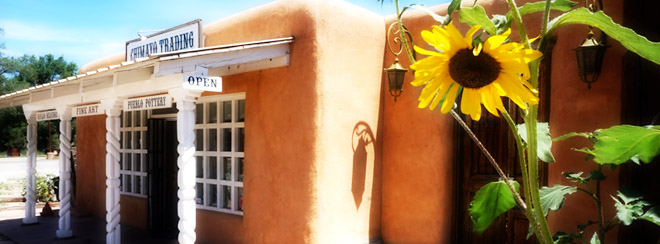
Come to the gallery to see where History Meets Art in Taos..
#1 Saint Francis Church Plaza
Ranchos de Taos, NM 87557
575.758.0504


We buy individual pieces or whole collections.
Contact us for the evaluation and resale of your collectible art.
We’re interested in locating relevant collections and original New Mexico artwork for purchase. We buy historic and contemporary relevant paintings, pottery, jewelry, textiles, weavings and more.
Contact us directly to discuss and evaluate your collection. If you’re an artist, contact us about the possibility of selling your art on consignment or direct wholesale purchase.
Copyright © 2023 Chimayo Trading Del Norte | Ranchos Del Taos, 87557 | All rights reserved.
Share this:
- Print (Opens in new window) Print
- Email a link to a friend (Opens in new window) Email
- Share on Pinterest (Opens in new window) Pinterest
- Share on X (Opens in new window) X
- Share on Facebook (Opens in new window) Facebook
- Share on LinkedIn (Opens in new window) LinkedIn
- Share on Reddit (Opens in new window) Reddit
- Share on Tumblr (Opens in new window) Tumblr
- Share on Pocket (Opens in new window) Pocket
- Share on Telegram (Opens in new window) Telegram
- Share on WhatsApp (Opens in new window) WhatsApp