
The Living Legacy of
Maria Poveka Martinez

By Rebekah Powers | May 2023
If there is one name that stands out in the history of southwestern pottery it is Maria Poveka Martinez of San Ildefonso Pueblo. The technique for turning iron red clay into a gleaming coal black finish was an important aspect of ancient pottery that had been lost. It was the recovery of that ancient knowledge that gained Maria worldwide recognition and catapulted her work into museums and history books worldwide.
Chimayo Trading has recently acquired a collection of historic pieces by Maria Martinez. It is incredibly rare to come across this number of works by arguably one of the most famous and collected Native American artists of all time. Her works have been catalogued and displayed by museums throughout the world so we feel fortunate to have acquired this number of significant small works from this renowned Pueblo master.

At 11, the young “Marie” watched her aunt, grandmother and her father’s cousin make pottery and she recalls “ learning by seeing”. Maria and all four of her sisters made pottery in late 19th century New Mexico, a critical time as Native American traditions were being lost by encroaching European cultures and commodification of native art forms. The practice of her craft was built around her beliefs, including a prayerful offering of sacred corn scattered across the clay beds before she would begin to collect the earth for her work.
Because of her consistently exemplary bowls, pots and plates, Maria was challenged with the rediscovery of ancient pottery techniques which she and her husband and collaborator Julian worked on for many years, experimenting until they eventually found the formula for turning red clay to gleaming blackware. The shining surface was elegant and sophisticated eventually supplanting their polychrome and red pieces. Working with her husband Julian they perfected their own matte black on burnished blackware, a style for which their was no earlier precedent.

Because of the couple’s willingness to travel to the World Fairs, to visit 4 sitting presidents, to attend festivals and fairs and demonstrate the tradition of Pueblo pottery to the world, they created an interest and appreciation for the art form, elevating what was once utilitarian to collectible works that were culturally significant and would become precious artifacts of the time.
Signatures on the bottom of Maria’s pots trace the timeline of the life and career of Maria Martinez. The earliest pots were signed “Marie” 1923-mid 1930’s and were often red clay or polychrome, decorated by Julian with helping hands from other family members.
Cream on red vase signed by a young “Marie”, decorated by Julian

The next period was characterized by the composite signature:
“Marie + Julian” representing the productive years of mid 1930’s -1943 when both Maria and Julian worked demonstrating the art in front of the Governors Palace in Santa Fe, and attending markets and fairs as their star began to rise.
Black Pots signed “Marie + Julian” would have been created after the reintroduction of the blackware technique.

After Julian’s death, Maria began to work with the wife of her son Adam, Santana, who assumed the role of surface decoration within the Martinez lineage from the years 1943-1956. These pieces were originally signed “Marie + Santana”. Around 1954, Marie would reclaim her Spanish name and began to sign “Maria + Santana”.
Black pottery signed with Santana, Maria’s daughter-in-law

Santana would then begin working with her husband Adam, establishing their own line of pottery at San Ildefonzo, carrying the traditions forward within the family. This led to an unexpected and magical pairing of Maria with her 3rd son Popovi Da.
Signing their work : “ Maria/Popovi” between 1956-1970 this collaboration produced even more refinement of design and ushered in a new era of exploration fueled by Popovi Da. Credited with his unique contributions including sienna pottery, polychrome revival pottery and gunmetal pottery, Popovi’s work with Maria is considered to be the most artful, creative and valuable of all.

Maria is the Spanish name and the one that will echo down through time, but many don’t know her Indian name Poveka, which means “Pond Lily”. To trace the entire trajectory of her life’s work through her signature, it is notable that toward the end of her life she made pottery without decoration and signed still with 2 names, but they were both her own. Signing “Maria Poveka” she managed to claim both the Indian and Spanish influences in her life as well as claim her individuality as an artist, a creator, and a teacher.
Among the many Pueblo matriarchs who have risen to prominence in the last 100 years, Maria Poveka Martinez stands alone in her dedication, perseverance and personal contribution to history.
Enter a world where history meets art at Chimayo Trading where you can hold a historic treasure in your hand. On display and available to collectors, we are currently offering several of the most prized ceramic pieces made by a humble woman with exacting standards who has become an icon: Maria Montoya Martinez.
If you have had a memorable experience with us in the past,
please leave a review.

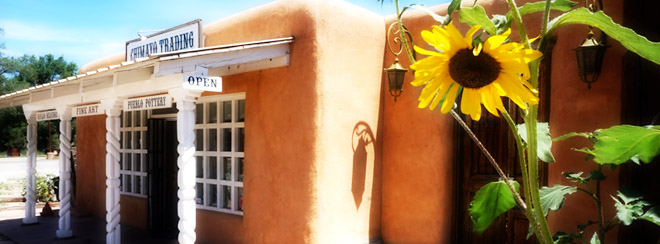
Come to the gallery to see where History Meets Art in Taos..
#1 Saint Francis Church Plaza
Ranchos de Taos, NM 87557
575.758.0504


We buy individual pieces or whole collections.
Contact us for the evaluation and resale of your collectible art.
We’re interested in locating relevant collections and original New Mexico artwork for purchase. We buy historic and contemporary relevant paintings, pottery, jewelry, textiles, weavings and more.
Contact us directly to discuss and evaluate your collection. If you’re an artist, contact us about the possibility of selling your art on consignment or direct wholesale purchase.
Copyright © 2023 Chimayo Trading Del Norte | Ranchos Del Taos, 87557 | All rights reserved.
Share this:
- Print (Opens in new window) Print
- Email a link to a friend (Opens in new window) Email
- Share on Pinterest (Opens in new window) Pinterest
- Share on X (Opens in new window) X
- Share on Facebook (Opens in new window) Facebook
- Share on LinkedIn (Opens in new window) LinkedIn
- Share on Reddit (Opens in new window) Reddit
- Share on Tumblr (Opens in new window) Tumblr
- Share on Telegram (Opens in new window) Telegram
- Share on WhatsApp (Opens in new window) WhatsApp