
Making A Case For Baskets

By Rebekah Powers | March 2021
A collection of baskets is a collection of time: the time it took for the grasses and reeds and bark to grow, the time to gather and the time to weave. Techniques have been perfected through hundreds of generations, going back 10,000 years and vary according to the tribe, location and point in history.
Tribes of the Southwest: Navajo, Apache, O’odham, Hopi, Pima and Yavalapai (Walapai)
Techniques: coiling, twining, plaiting
A historic basket carries more than berries and reeds. A fine collectible basket is a sacred record of a place in time within a tribe, their practicality, their priorities and their aesthetics, a woven history.
In some ancient creation stories, a female spirit, Spider Woman, wove the world into being. The process of weaving is a meditation and weavers were deep thinkers who prayed and sang as they wove.
A basket is a living art form and serves as an integral part of the culture in varied ways: as a cradle, a drum or a spiritual vessel for ceremonies.
Before sheep with wool to weave, there were basket weavers.
Before pottery, baskets served many of the same functions, including carrying water, gathering seeds, and transporting goods.
For nomads moving along water courses, materials were abundant and the vessels were lightweight and durable. The uses for baskets ranged from utilitarian to the ceremonial. Tradition was passed down through hundreds of generations and is endangered in today’s world where the art form is languishing among the young.
Therefore, the baskets from the past are a letter written in disappearing ink.
The value of Indian baskets has risen steadily over the years and is determined by several factors including identification of the weaver, the fineness of weave, high stitch counts and uniformity of the weave.

Hopi – Hopi means the “People of Peace”.
Climate change and the introduction of invasive species have interfered with traditional plant materials weakening the native willows used in basketry. Other plants have reproduced with invasive species to create a sterile, inedible plant, an inferior version of what they had relied on for so long. Some of the plants used in Hopi baskets: Yucca, Galleta Grass, Wicker, Dune Broom and Rabbitbrush, which can be dyed bright colors.
As in antiquity, the Hopi still gather wild plants for the materials, use natural dyes and only harvest after certain ceremonies, according to tradition. Because the Hopi culture is confined by the surrounding Navajo Nation, a basket weaver may have to travel over 300 miles to gather materials. Baskets are vital to the Hopi culture in these ways: Trade, Lineage, Gifts, Kiva ceremonies and rituals.
The future of Hopi basketry is dependent on access to their traditional resources and threatened by political, social and natural changes. Art experts and collectors agree that Hopi baskets are among the finest produced by the Southwest’s native peoples.
Secrets of the coil indicate the social status of the weaver.
An open gate connotes the work of an unmarried girl
A partially open gate indicates a married woman of child-bearing age. A closed gate signifies a widow or woman beyond child-bearing age.
Hopis believe that gift giving is a completion of the cycle of generosity ensuring rain and bountiful crops. A bride traditionally gives her groom a wedding basket which years later will be buried with him to carry him to the afterlife. She may also spend years making baskets to “gift back” people who helped with the wedding ceremony.

Another special Hopi ceremony is the Basket Dance
During the Basket Dance, chanting women enter the village plaza in a long line, form a swaying circle and then each rhythmically raise and lower a fine plaque made by her or her tribal sister. At some point the women throw their fine baskets like frisbees across the plaza and if you are lucky enough to catch one and strong enough to hang on to it, it is yours to keep.

Apache
The finest Apache baskets are magnificent and mysterious. Some of the trays with figures and abstracted patterns are a wonder to behold. Some of their geometric symbols represented coyote tracks, butterflies, water, and lightning. Apache weavers also added pictorial designs of ceremonial dancers, human figures, deer, horses, dogs and mountain lions.

Pima
The best Pima baskets are considered the finest of all Southwestern baskets. Their mastery extends to trays as large as 24” in diameter to tiny miniatures less than an inch wide and almost weightless. The Pima call themselves Akimel O’odham, the “River People”. They are cousins of the Papago who call themselves Tohono O’odham, descendent of the great Honolam culture of southern Arizona.

Tohono O’odham
The “Desert People” are one of the largest tribes currently making baskets. Very similar to Pima, collectors consider baskets with large starts in Devil’s Claw to be Tohono O’odham. They also began making finely coiled horsehair miniatures. Their most popular design is the Friendship Dance of human figures holding hands in a circle.
Our rare collection of fine baskets represents the best weavers from many traditions.
Together they constitute a museum quality perspective on this refined art form and offer another glimpse into the creative cultures of the first peoples of America. A basket is a piece of history that you can hold in your hands.
If you have had a memorable experience with us in the past,
please leave a review.

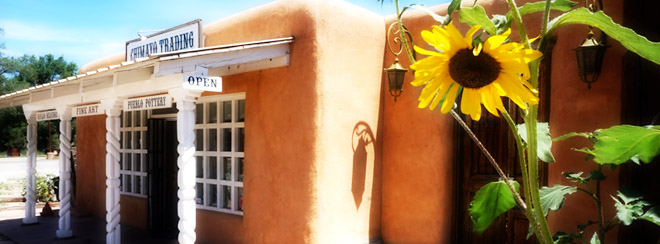
Come to the gallery to see where History Meets Art in Taos..
#1 Saint Francis Church Plaza
Ranchos de Taos, NM 87557
575.758.0504


We buy individual pieces or whole collections.
Contact us for the evaluation and resale of your collectible art.
We’re interested in locating relevant collections and original New Mexico artwork for purchase. We buy historic and contemporary relevant paintings, pottery, jewelry, textiles, weavings and more.
Contact us directly to discuss and evaluate your collection. If you’re an artist, contact us about the possibility of selling your art on consignment or direct wholesale purchase.
Copyright © 2023 Chimayo Trading Del Norte | Ranchos Del Taos, 87557 | All rights reserved.
Share this:
- Print (Opens in new window) Print
- Email a link to a friend (Opens in new window) Email
- Share on Pinterest (Opens in new window) Pinterest
- Share on X (Opens in new window) X
- Share on Facebook (Opens in new window) Facebook
- Share on LinkedIn (Opens in new window) LinkedIn
- Share on Reddit (Opens in new window) Reddit
- Share on Tumblr (Opens in new window) Tumblr
- Share on Telegram (Opens in new window) Telegram
- Share on WhatsApp (Opens in new window) WhatsApp